The Polymer and Colloids Group
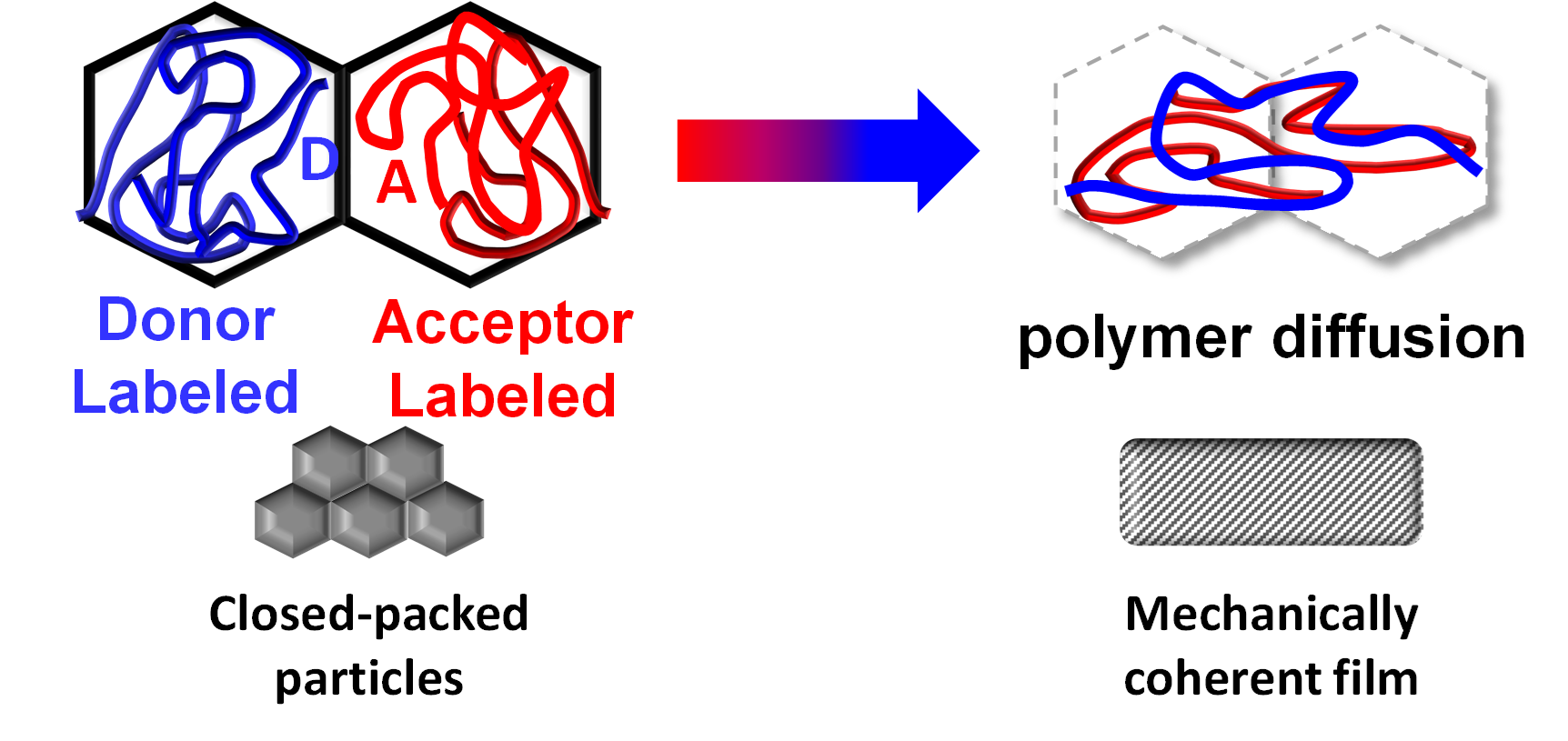
For more than 20 years we have worked with scientists in the coatings industry to provide a knowledge base to enable them to prepare waterborne coatings that are environmentally compliant with high performance. An important challenge in waterborne coatings technology is to reduce the emissions of volatile organic compounds (VOCs) without sacrificing performance and properties. In the 1990s and early 2000s, the challenge for the industry was to replace solventborne coatings with waterborne coatings. We developed methods based on fluorescence resonance energy transfer (FRET) to study polymer diffusion across interfaces in latex films. This is the step that leads to mechanical strength in the coating. In these experiments, we synthesized latex nanoparticles that modeled industrial systems, introducing donor or acceptor dyes into the nanoparticles. In this way, we were able to develop an understanding of how various additives or various changes in nanoparticle morphology affect film formation. We believe that the knowledge generated in our laboratories has contributed to the formulation of every can of latex paint available today.
Since 2014, we have been working closely with scientists at BASF to study mechanistic aspects of novel coatings formulations developed in company laboratories. In one set of experiments, we examined a thermoset coating based on an acid-rich oligomer that was synthesized at BASF in a solvent-free process. This oligomer was partially neutralized and dispersed in hot water to form latex particles as a secondary dispersion. Cross-linking was provided by a reaction with a bis-epoxide. We studied molecular phenomena that occurred both in the dispersed phase and in films formed from these dispersions.
Liu, Y.; de Oliveira Silva, P. P.; Tran, K.; Zhou, H.; Emsermann, J.; Zhang, M.; Ho, K.; Lu, Y.; Soleimani, M.; Winnik, M. A. Molecular aspects of film formation of partially cross-linked water-borne secondary dispersions that show skin formation upon drying, Macromolecules 2019, 52, 9536−9544. DOI:10.1021/acs.macromol.9b02103
More recently, we have been working to develop a mechanistic understanding at the molecular level of two-component (2K) waterborne polyurethane (WBPU) coatings. These coatings consist of a water-dispersible (hydrophilically modified) polyisocyanate (PIC) and a polyol latex. BASF is particularly interested in latex polyols prepared by emulsion polymerization. Solventborne polyurethane coatings provide the highest performance for industrial coatings. The goal now is to achieve this level of performance in a waterborne formulation that is more environmentally compliant. The chemistry of WBPU coatings is complicated by several factors. First, when dispersed in water, the NCO groups of the PIC react with water to produce amines that react with the PIC to form polyureas. The aging time in the dispersion prior to application to a substrate is an important aspect of the performance of the coating. This reaction also limits the pot life of the mixture. Second, the painter mixes the components just before use. This means that the company has little control over how the components are employed. For example, the PIC as sold is a viscous liquid that the painter has to dilute with an organic solvent prior to mixing it with the polyol dispersion. The choice of solvent can affect the properties of the coating. Improved knowledge here would enable the company to provide more meaningful guidance for the use of the product. We have been studying processes in the dispersed phase as well as aspects of coalescence, film formation, and cure reaction in this type of coating.
Liu, Y.; Zhou, H.; Tran, K.; Glenn, J.; Zhang, M.; Lu, Y.; Ho, K.; Soleimani, M.; Lucas, F.; Winnik, M. A. Monitoring polymer diffusion in a waterborne 2K polyurethane formulation based on an acrylic polyol latex, Macromolecules, 2020. 53 (24), 10744-10753, DOI:10.1021/acs.macromol.0c02129
Liu, Y.; Glenn, J.; Tran, K.; Zhang, M.; Zhou, H.; Soleimani, M.;. Lucas, F.; Winnik, M.A. Film formation of waterborne 2K polyurethanes: effect of polyols containing different carboxylic acid content, Macromolecules, 2021, 54 (17), 7943-7954, DOI:10.1021/acs.macromol.1c01172